
Origins
Though today we generally think of Planned Parenthood as a powerful political organization for reproductive healthcare, the wildly controversial clinic all began with the vision of one woman: Margaret Sanger. The history of Planned Parenthood is inextricably bound to Sanger’s politicized life. Margaret Sanger was born in New York in 1879 to a family of Irish immigrants and eventually grew up to study nursing practices at Claverack College and the Hudson River Institute. After marrying and moving to New York City, Sanger found herself increasingly surrounded by the up-and-coming radical, bohemian scene. It is from this new community that Sanger’s interest for female sexuality and reproductive health grew. Time recounts the pivotal moment that influenced Sanger to pursue reproductive justice as a method for women’s liberation; the tragic ending to Sadie Sachs’ DIY abortion:
“I was resolved…to do something to change the destiny of mothers who’s miseries were as vast as the sky.”
Sanger’s encounter with Sadie Sachs led her to open the very first birth control clinic in Brooklyn, New York in October of 1916, but unfortunately the location was only operating for nine days before it was shut down. Sanger herself was actually arrested and served time for offenses related to running the clinic because of the Comstock Law, which had deemed birth control to be obscene and illegal. According to Planned Parenthood’s own website, however, her incarceration rallied masses of people towards her cause. Slowly but surely, with the help of fundraising and the development of gradually more progressive legislation, Sanger was able to establish more clinics and the Birth Control League of America. In this sense, the ideological origins of Planned Parenthood are rooted in Sanger’s desire to help others. This is certainly something embodied by Planned Parenthood today, as will later be discussed.
Not everything about Sanger’s activism aligned with the message of equality currently espoused by Planned Parenthood, however. Along with the reproductive rights movement, Sanger was heavily involved in the now-despised eugenics movement. Partially inspired by the works of Mendel and Darwin, eugenics advocates worked off of the argument that not everyone was fit to reproduce. Sanger was a part of this movement while growing the organization that would someday become the International Planned Parenthood Federation and advocated for several questionable actions, namely the forced sterilization of the mentally ill and African Americans. In her 1921 speech, “The Eugenic Value of Birth Control Propaganda,” Sanger stated,
“…the unbalance between the birth rate of the “unfit” and the “fit”, [is] admittedly the greatest present menace to civilization…the most urgent problem today is how to limit and discourage the over-fertility of the mentally and physically defective.”
This has proven to be a dark shadow across the legacy of Sanger and her movement. Though she herself was a pioneer for reproductive justice in her time, she was not without fault in her thinking. Many womanists of the time even distrusted the reproductive rights movement because of people like Sanger. Certainly, Sanger’s past morals regarding reproductive technologies were negative at the very least. Today, Planned Parenthood has distanced itself from the dark ideology behind eugenics and evolved into something far less horrific.
Progress
Despite Sanger’s own questionable ethics, she was able to develop Planned Parenthood into an international organization that pioneered reproductive health movements. Even after leaving her position as the president of Planned Parenthood in 1959, Sanger worked tirelessly to research family planning methods. It was this work that led to the invention of the oral contraceptive known today as “the pill.” From then on, Planned Parenthood and similar organizations entered what their website dubs “A New Era For Women.” Even before Roe v. Wade, Planned Parenthood was providing women across the United States with medical advice and assistance in regards to family planning. New innovations allowed the organization to provide a wider array of contraceptives such as the pill and intra-uterine devices, but also educational tools like more accurate sex education and other services like testing for sexually-transmitted diseases and different cancers.
In examining Planned Parenthood’s mission statement, one can see where the organization aligns themselves ideologically:
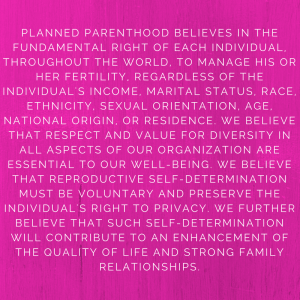
Planned Parenthood has positioned themselves as an objective health provider, and this mission statement certainly reflects that. In treating people regardless of the statuses listed above, the ideology upholding PP’s healthcare services is one of inclusivity and fairness. It is certainly a more progressive view than the pro-eugenics stance of Margaret Sanger. Combining this mission statement with a diverse selection of family planning services, Planned Parenthood would seem to be an ideologically sound organization. Healthcare, after all, is something that is a basic need for all people. Politicization of health issues, however, has led Planned Parenthood to become more involved in more complicated ideologies.
Today
Having entered the 21st century as a longtime advocate for women’s healthcare, Planned Parenthood has effectively established itself as a giant within the women’s rights/feminist movement. Though other organizations are more explicit in their feminism, Planned Parenthood enjoys a comfortable relationship with feminist advocates and organizations alike. However, if one is unsure as to what exactly that entails, looking at PP’s financial dealings can help orient one to the oftentimes political bent to their ideology. The organization annually publishes a report detailing progress and basic information for that year. These reports detail just exactly where Planned Parenthood receives their monetary support from (to a degree) and can help one understand why politics are so essential to the ideology of their work. The 2014-2015 report lists revenue from from 5 different sources:
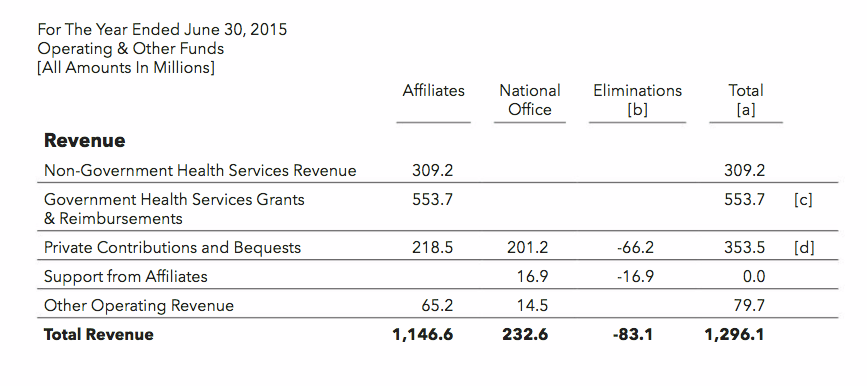
According to FactCheck.org, monetary support under “Government Health Services Grands & Reimbursements” comes from two sources: Title X Family Planning Program funding and Medicaid. Unfortunately, such specific information is not included in this chart. Though overall, government funding is only around one third of PP’s overall revenue, it certainly is a major influencer in the resources and practices that Planned Parenthood can access and provide. Consequentially, Planned Parenthood today is an inherently political organization that has a vested interest in certain governmental interests. Ultimately, Planned Parenthood must partake in certain political ideologies if they are to financially support their community-based healthcare.
Regarding the rest of their revenue, this list certainly has a level of transparency, but PP fails to detail exactly where specific donations come from within more vague categories like “Private Contributions and Bequests” and “Support from Affiliates.” Despite this, the data shows that a significant amount of Planned Parenthood’s revenue comes from personal donations, which means that people out there are actively fundraising and bringing awareness to the organization. Conservative website NewsBusters.org provides an extensive list of celebrities who have publicly come out against of the GOP’s efforts to defund Planned Parenthood. While one cannot say that each of the celebrities mentioned has definitively donated money to Planned Parenthood, their societal clout is undeniably linked to the 353.5 million dollars PP raked in from private contributions. This again can be tied to PP’s dedication to their mission to provide comprehensive healthcare to women across America.
Planned Parenthood is a healthcare provider that is held accountable to non-discriminatory laws like any other medical practitioner. They do not deny services to patients based on political affiliation. Planned Parenthood Action Fund, however, allows PP to extend a political arm out into the public and influence opinions and policy. The PPAF “About” page describes itself as a non-partisan group, but in truth things are usually not that way. Again, due to legal restrictions, Planned Parenthood is legally unable to spend money in politics. However, the Action Fund and other PACs have more leeway in terms of where their money can go. In previous election cycles, various PACs under Planned Parenthood donated millions of dollars towards election and re-election efforts of Democratic lawmakers. Most notably, and recently, Planned Parenthood’s Action Fund contributed heavily to Hillary Clinton’s campaign.This means that Planned Parenthood is inextricably bound to the political conversations happening in America right now, and that the promotion of their healthcare ideology is partially contingent upon the maintenance of a left-leaning political ideology. In fact, it is this very partisan slant of the organization that brings it so much controversy and influence in current American discourse.
Onward
Ultimately, Planned Parenthood is a complicated organization with a complicated history. Its ideology has fluctuated with the times and is reflective of the fast pace of social change and progress within the last century or so. Said ideology has been influenced by PP’s leaders, social movements, technological advancements, and even political agendas, so it would be unnatural to confine it to one singular word. Whether pro-choice, pro-life, or anti-either-of-those-terms, one can look at the facts of the matter and conclude that at the very least, the Planned Parenthood of today is sound in ideology that provides comprehensive healthcare to those who need it.
 cristina aragon